
How a Piece of the Berlin Wall Ended Up in Lower Manhattan
February 23, 2026
In a small area surrounded by a low fence right by Pumphouse Park in Battery Park City, you’ll find a piece of history that tells a story of resilience, reunification and hope.
Passersby might wonder why this random slab of upright concrete covered with peeling paint has such a place of prominence. It’s because the installation isn’t just a regular piece of wall: it’s an intact slice of the Berlin Wall, the barrier that once divided East and West Berlin. This piece was located in downtown Berlin in the area between Potsdamer Platz and Leipziger Platz, part of the inner wall designed to prevent East Germans from escaping. The wall fell in 1989, marking the end of the Cold War and a seismic shift in global politics. Since then, pieces have ended up all over the world — in museums, private collections, government institutions and, in the case of this particular piece, on a side street near the waterfront in Lower Manhattan.
The wall segment stands 12 feet high and eight feet wide, weighing 2.75 tons. Its journey has been long and arduous. But let’s back up.
After World War II, Germany was split into two sections, the eastern half run by the Soviet Union, and the western half controlled by capitalist allies the United States, Great Britain and France. To prevent East Germans seeking an escape from the Soviet forces from fleeing to the west, in 1961, East German leaders ordered the construction of a nearly 100-mile long wall through Berlin that would physically divide the city in half. The wall was heavily patrolled, with shoot-to-kill orders for anyone trying to cross over to the other side.
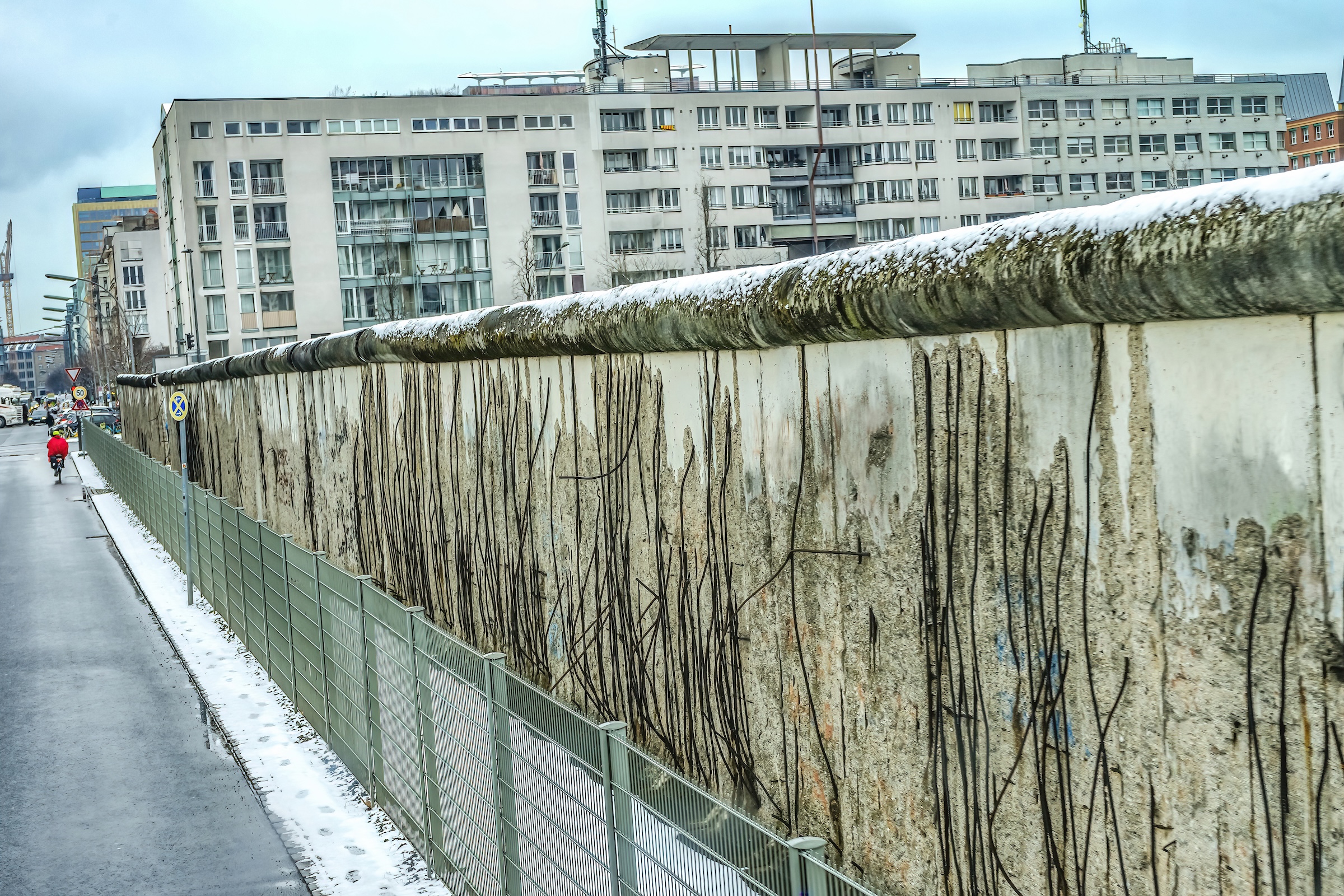
For years, the wall was a drab piece of concrete symbolizing the Cold War’s brutal dividing lines between communism and capitalism. But things changed when French-born artist Thierry Noir moved to West Berlin in 1982 at the age of 22. He lived close to the wall and found himself captivated by it.
“I realized that the Berlin Wall was kind of taboo in German society,” Noir said in a video produced by the Battery Park City Authority (BPCA).
Noir began painting sections of the wall. At first he started with more complicated designs, but they were soon covered in graffiti. He switched to simpler designs, like the one on display in Lower Manhattan, which were easier to repaint and repair. He also stuck to simpler designs for a more practical reason: he could be arrested at any time for defacing the wall, and wanted to move quickly.
“You can paint quite a lot in a short time,” he said of the technique. He estimated that he painted four miles of wall throughout Berlin over the course of six years.
On November 9, 1989, the East German government announced the end of the East/West division. Protestors began tearing the wall down, with a full demolition taking place over the course of a few years as West and East Berlin reunited. Pieces of the wall went on display around Germany, and the slab that is now located in Lower Manhattan ended up in the Federal Ministry for the Environment building. Noir repainted it in 1997, sticking to the simple figure design with bold lines he had painted on the wall originally. He told the BPCA that there was no specific meaning to the art, and that it was a general nod to the younger generations’ power to spearhead change.
“Our parents have done good stuff, but we are better. It’s our turn now,” he said. “Everybody can see their own message.”
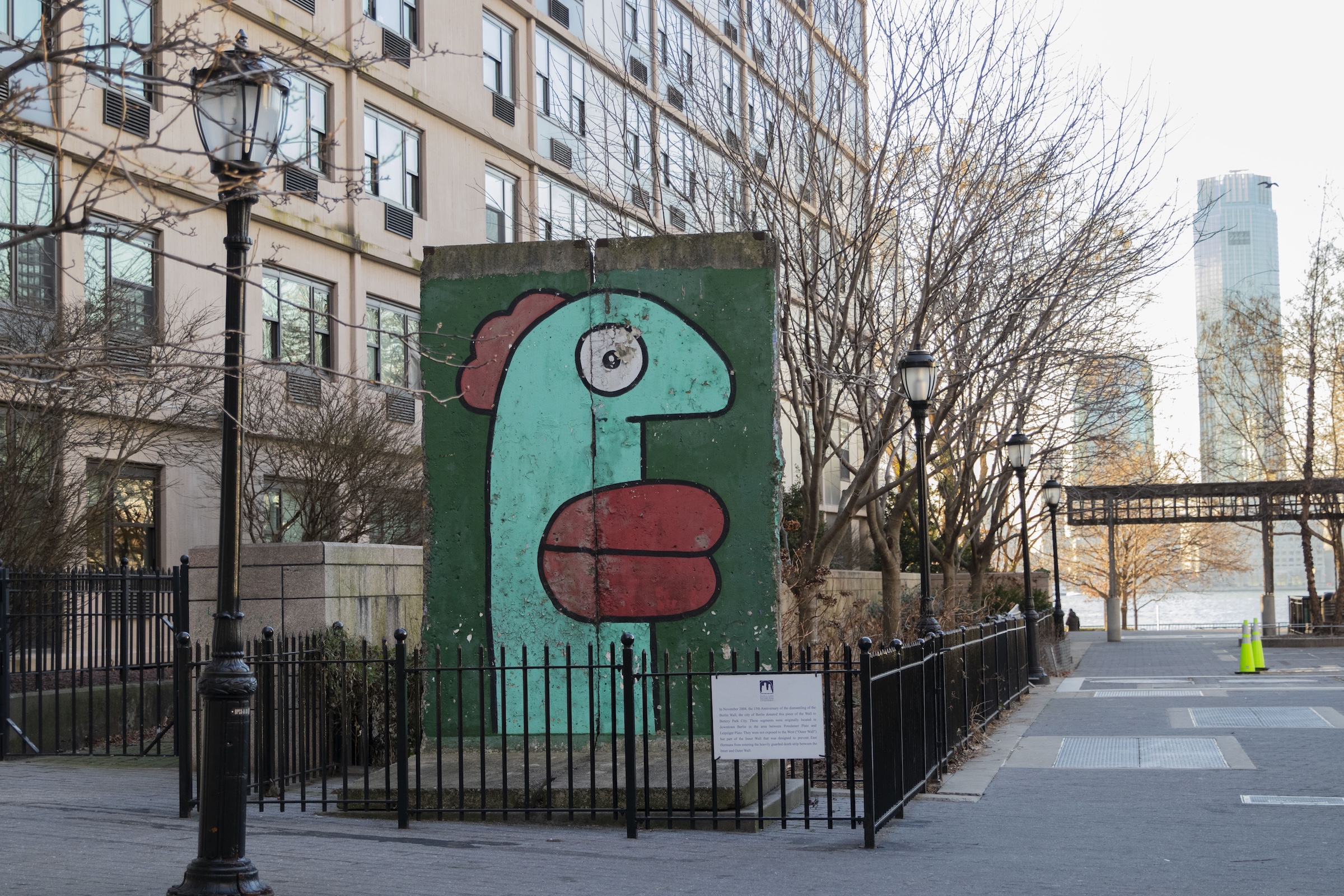
In 2004, the German Consulate gifted the piece of wall to New York City as part of the 15-year anniversary of the wall’s fall. The wall was specifically given to the BPCA in recognition of its commitment to education and the display of public art.
Now, the wall segment proudly stands on its own strip of sidewalk, with a plaque marking it as an Homage to Liberty. And unlike when it was first erected in Berlin, you can freely walk past it any time you want.
main photo: courtesy Battery Park City Authority


