
Marking 100 Years Since Swimmer Gertrude Ederle’s Historic Ticker-Tape Parade
August 27, 2026
On August 27, 1926, two million people gathered in Lower Manhattan to witness a historic ticker-tape parade. No, it wasn’t a celebration for a long-suffering basketball team. This parade was for Gertrude Ederle, a 19-year-old Olympic swimmer who just a few weeks earlier had become the first woman (and fastest person altogether) to swim across the English Channel. A native New Yorker, Ederle was met with massive acclaim in her hometown; the ticker-tape parade up Broadway was one of the most well-attended up to that point, and a rare fête for an individual athlete rather than a winning team.
Ederle, known to her loved ones as “Trudy,” grew up on the Upper West Side of Manhattan, where she lived with her five siblings and her parents, who owned a butcher’s shop on Amsterdam Avenue. As a child, Ederle had significant hearing problems, which historians suspect stemmed from an early case of measles. She was introduced to swimming early — per Hannah Hubert, executive director of the Trudy Ederle Foundation, her father put a rope around her waist and threw her into the water — and quickly demonstrated a natural aptitude for it. She and her sister Meg began training with the Women’s Swimming Association (WSA), where Ederle excelled, making it all the way to the 1924 Olympics in Paris, winning a gold medal as part of the U.S. team.
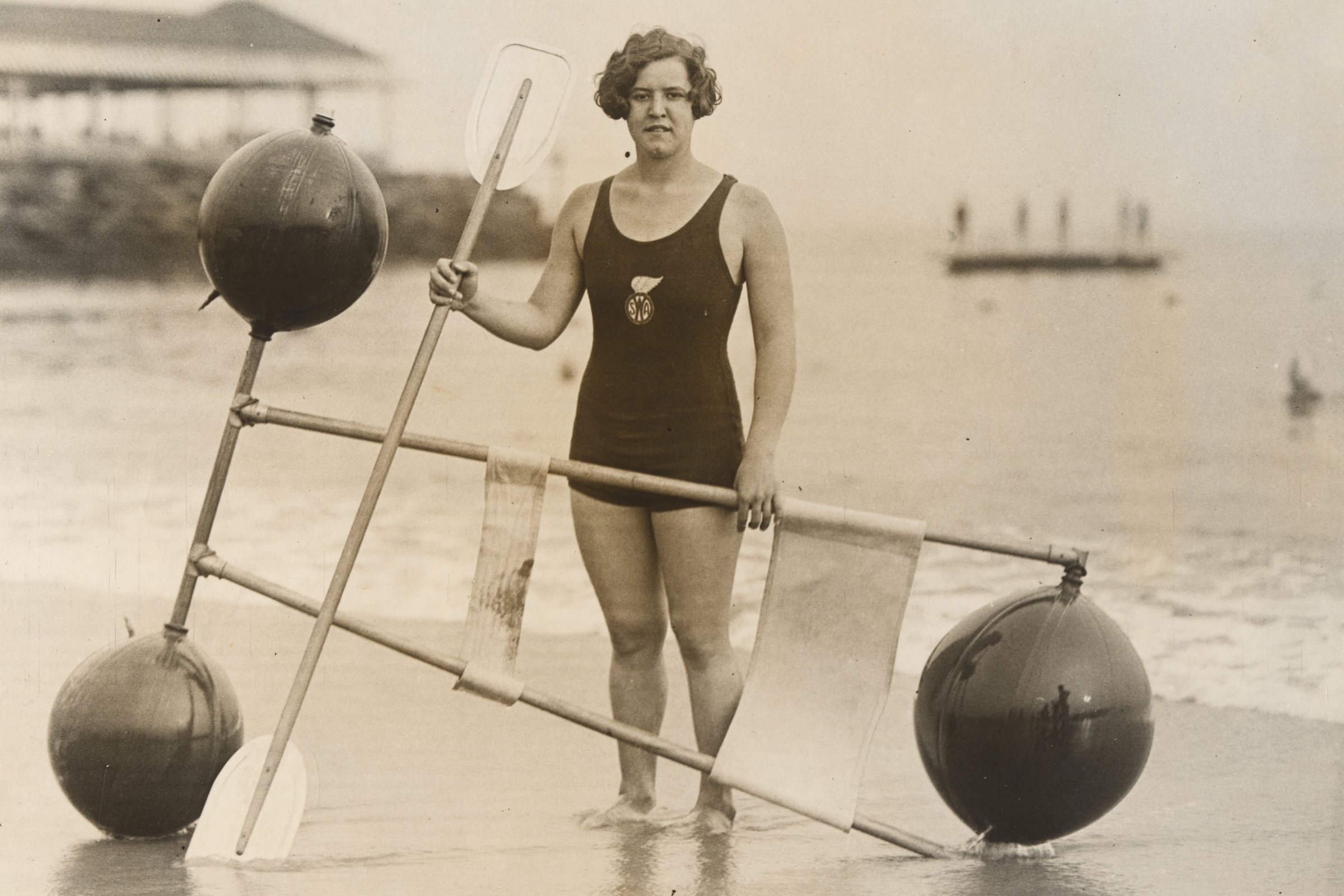
Post-Olympics, in 1925 Ederle achieved a record seven hour, 11-minute swim from Battery Park to Sandy Hook, New Jersey. The 22-mile crawl inspired her to tackle a new challenge: swimming across the English Channel. At the time, only five men had successfully made the 20-plus mile crossing. On Ederle’s first attempt, coach Jabez Wolffe pulled her out of the water before she could complete the swim, a decision she strongly disagreed with. But on August 6, 1926 — wearing a two-piece swimsuit designed just for her, a scandal at the time — Ederle successfully made a 14 hour and 34-minute journey from Cap Gris-Nez in France to Kingstown, Kent, England. The swim was a record one hour and 59 minutes faster than the fastest swimmer who preceded her, and Ederle held that title until 1950. Of her achievement, Ederle famously said, “I just knew if it could be done, it had to be done, and I did it.”
Ederle came back to New York after the swim, where she was celebrated with a ticker-tape parade on August 27. She was the first woman to receive an individual ticker-tape parade in New York, and the event marked one of only two ticker-tape parades held for swimming in the city’s history. The Queen of Waves, as she was named, was welcomed by thousands of fans, including Mayor Jimmy Walker, who personally congratulated her.
Ederle then went on a two-year vaudeville tour across the country, where she performed swimming feats in a portable pool. The tour was, unfortunately, too much for her body, and took a further toll on her hearing; by the tour’s completion, she was nearly completely deaf. Then in 1933, she became paralyzed for a year after falling down a set of stairs. Doctors told her she would never swim or even move again, though after extensive rehabilitation, she was able to regain movement after six years. In her later years, Ederle taught swimming at the Lexington School for the Deaf and to children in Highlands, New Jersey. She died in her New Jersey home in 2003, at the age of 98.
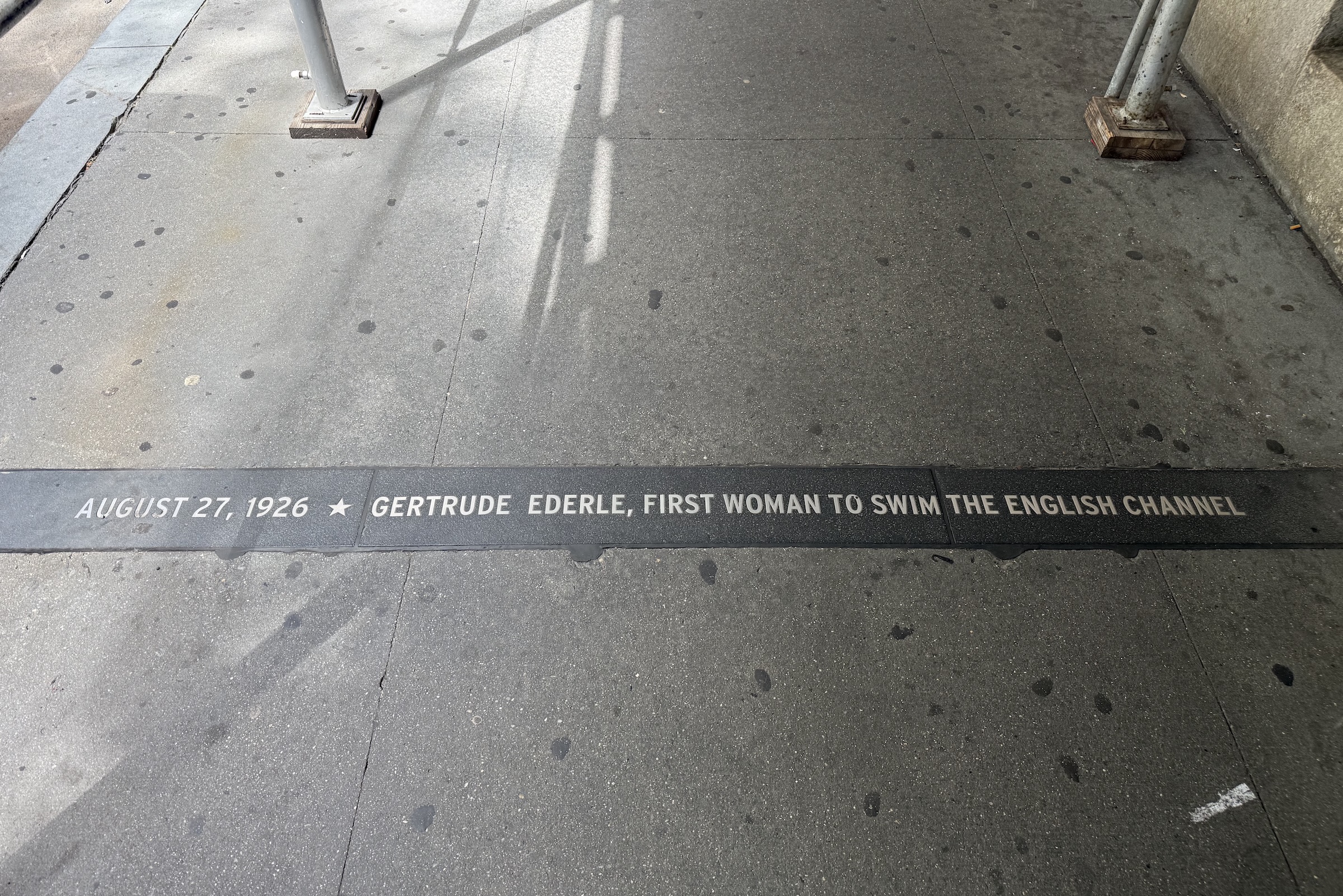
You can honor Ederle today, and every day, by visiting her marker on Broadway, just north of Beaver Street. Learn more about her life in “TRUDY: Gertrude Ederle — The Life Behind the Headline,” by Tobias Kolesnyk, the director of strategic communication at the Trudy Ederle Foundation, which you can purchase online.
main photo: New York World-Telegram and the Sun staff photographer – Library of Congress Prints and Photographs Division. New York World-Telegram and the Sun Newspaper Photograph Collection

