
A Whiskey Shot Heard ‘Round the World: How NYC’s Taverns Helped Spur the American Revolution
March 3, 2026
New York City has always been a party town. In 1757, with the city under British rule, lawyer William Smith Jr. described it as “one of the most social places on the continent.” Decades later, as the American Revolution approached, New York was the second most populous city in the British North American colonies after Philadelphia, with Boston and Charleston close behind. A vital commercial port, goods and information entered New York’s waters daily, and constant travel in and out of the harbor connected people throughout the colonial landscape. The city’s taverns provided space for these exchanges and communal needs, making them among the most important structures in colonial New York.
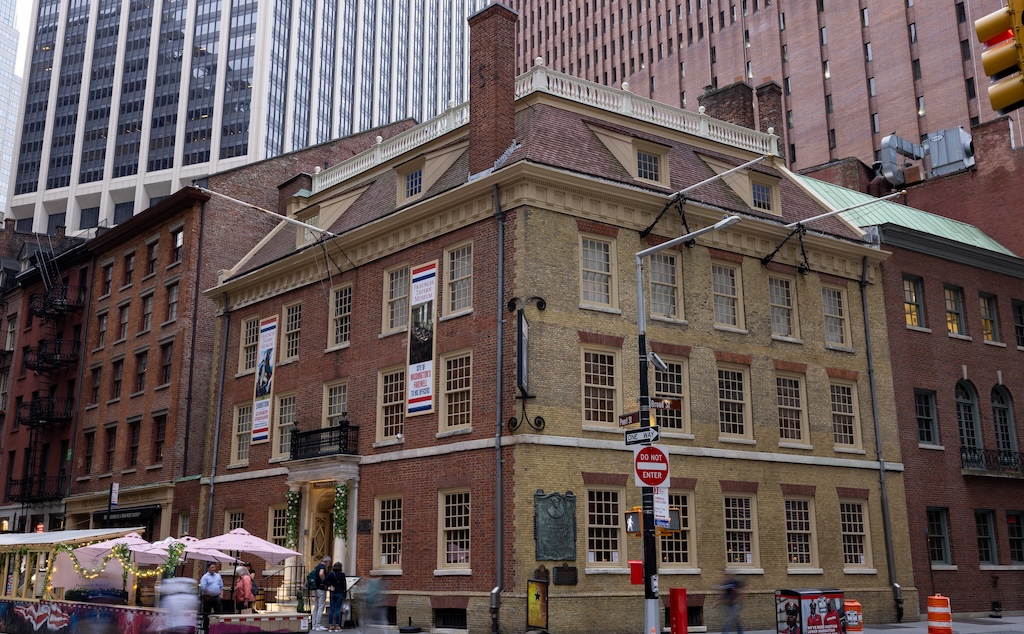
Traditionally, colonial taverns, also known as public houses, were places where travelers could find lodging, food and drink. Taverns were also gathering places for local communities, serving as sites of celebration for everything from holidays to dinner parties. But early American taverns were more than centers of amusement and merriment. In urban centers like New York, dockside establishments like Fraunces Tavern, which opened at the corner of Broad and Pearl streets in 1762, played an important role in colonial life and often reflected the population and its needs. They connected the cities to the greater Atlantic world, as networks of merchants, sailors, travelers and tradesmen frequented them.
As ships came and went, crews would leave newspapers, broadsides (large pieces of print used to announce events or proclamations), mail and gossip from across the British Empire. Taverns were hubs of communication and exchange, where patrons — often white, literate men — could learn about the ongoing state of business affairs and colonial government and discuss the latest news.
As centers of information and discourse, New York’s taverns held a close connection to civic decision-making. The first recorded tavern in colonial New York was the Stadt Herbergh, which began operating in 1643. Before the English took control of New York City, New Amsterdam, as it was then known, was under Dutch rule. The Stadt Herbergh soon became New Amsterdam’s official state house, the Stadt Huys in 1653. Following the transition of power in 1664, the Stadt Huys continued to serve as the English City Hall.
Sir Francis Lovelace, the second Governor of New York, recognized the significance of the Stadt Huys in the city and chose to build one of the first English taverns nearby. The establishment, which bore the Governor’s name, strengthened the link between taverns and colonial decision-making. As the Stadt Huys fell into disrepair, the Lovelace Tavern on Pearl Street began serving as the new City Hall in 1699. But, like the Stadt Huys before it, the Lovelace Tavern was brought down by 1706. Today, remnants of the Lovelace Tavern can be viewed beneath a glass floor just across the street from the still-standing Fraunces Tavern, which would later play its own instrumental role in the city’s civic life.
As the 18th century progressed, taverns in New York City acquired a reputation for rowdiness. In 1774, Massachusetts lawyer John Adams observed: “At their Entertainments there is no Conversation that is agreeable… They talk very loud, very fast, and alltogether. If they ask you a Question, before you can utter 3 Words of your Answer, they will break out upon you, again — and talk away.” Clubs and associations began meeting in taverns to introduce structure and order in these lively settings. Tavernkeepers encouraged such gatherings, as they were profitable. Although there was still plenty of drunken disorder, these clubs fostered camaraderie, and as the conversation turned to the injustices of Britain’s taxation, many found a new common cause to discuss.
The Stamp Act of 1765, which imposed a tax on printed goods ranging from legal documents to playing cards, led New Yorkers to use taverns and coffeehouses (another popular communal space) to discuss, debate and mobilize. Opposition to the act intensified, and on October 31, just one day before the tax was to take effect, more than 200 merchants gathered at the City Arms Tavern, located at what is now 115 Broadway. A collective agreement was made among the merchants that they would not import English goods until Parliament revoked the tax.
This meeting, overheard by mariners and young boys at the tavern, grew into a citywide disruption. A riot ensued into the next day, and effigies of the unpopular lieutenant governor and the devil were marched in the streets. The wave of opposition to the tax gave rise to the New York chapter of the Sons of Liberty, an underground organization seeking to resist what they believed was an infringement of their rights. As England gained a new Prime Minister, the announcement to repeal the unpopular tax reached the city in May 1766. This short-lived victory was celebrated at taverns across the city.
In the years leading up to the war, the city’s taverns remained central as patrons gathered to learn of the latest tax acts, proclamations and events occurring in the surrounding colonies — for within these taverns, the beginnings of a revolution were finding its voice.
Theresa DeCicco-Dizon is a public historian and museum educator based in New York City.
main photo: Washington’s farewell address to his officers at Fraunces Tavern (painting by Alonzo Chappel, image courtesy Gotham Center for New York History)


