
LM Live Recap: How the Woolworth Building Shows ‘What It Means to Preserve Greatness’
February 3, 2026
On January 28, LM Live and Untapped Cities teamed up for an extra-special event — an exploration of the past, present and future of the Woolworth Building, held inside the neo-Gothic masterpiece itself. Attendees gathered on the Cass Gilbert-designed building’s 26th floor to enjoy a reception, site-specific artwork from Untapped New York artist-in-residence Aaron Asis, and a fascinating panel featuring leading voices in New York City’s cultural and architectural spheres.
Moderated by Justin Rivers, Untapped New York’s chief experience officer, the panel featured a who’s who in architecture: Carol Willis, founder and director of the Skyscraper Museum; Gregg Pasquarelli, founding principal at SHoP Architecture; Ron Castellano, founder of Studio Castellano and Nate Rogers, partner at Beyer Blinder Belle Architects, all of whom were on-hand to offer their thoughts on the Woolworth’s significance and legacy. Though the Woolworth Building, which Gilbert built for Woolworth company founder F.W.W. Woolworth in 1913, is often considered a “Cathedral of Commerce” and testament to capitalism, the panelists focused on its role as a champion of adaptive reuse, a symbol of artistry and the power that beauty can bring to civic buildings
“Tonight, we’re not just talking about a building,” Rivers said in his intro. “We’re talking about what it means to preserve greatness, how cities evolve without losing their souls, and how architecture shapes the way we remember who we are and imagine who we might become.”
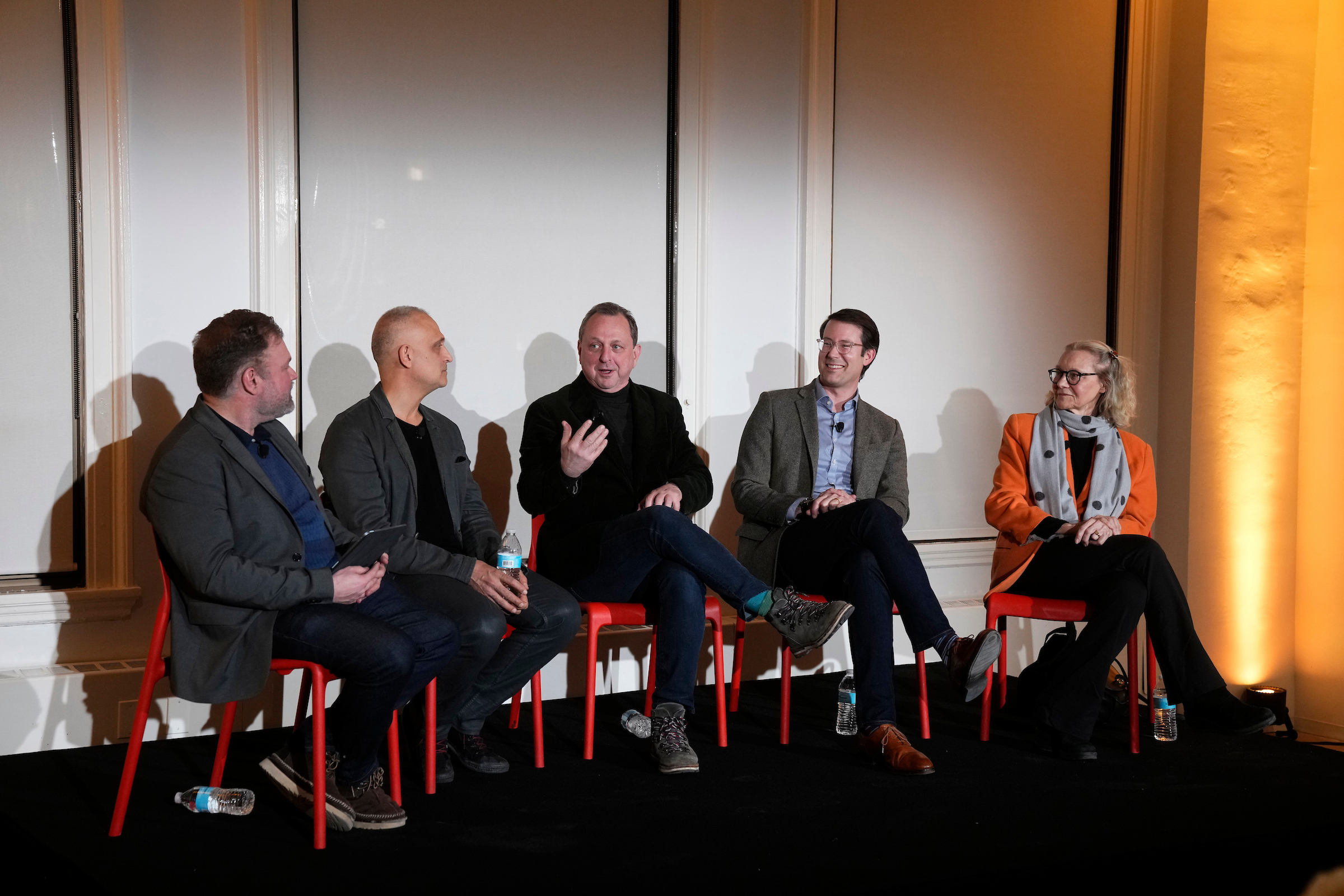
The panelists touched on the Woolworth’s indelible impact on the city — one they made sure to note was intentional. As Willis pointed out, Gilbert’s selling point to Woolworth was that the building would be a civic ornament. “It had to have a civic character so that the silhouette on the skyline was something that made New Yorkers proud,” Willis said. Pasquarelli, who used to work in an office across the street (and now works in the building) lauded the building facade’s ornate ornamental terra cotta — and mentioned that at some point he realized he’d begun to incorporate it in his own more modernist designs.
“I’ve been staring at it for eight years and clearly that got into my DNA,” he said.
The panelists also discussed how the Woolworth’s transformation from a massive office building to a mixed-use residential and commercial space reflects the evolution of the city and Lower Manhattan itself. “It was almost like a coral reef,” Rogers said. “It cultivates a very diverse and robust kind of economy.”
And Castellano celebrated future plans to give the public more access to the Woolworth’s spectacular lobby — his group is working to activate unused commercial and lobby spaces on the ground floor, with the Wonder Bar, a new all-day cafe, soon to fill the former Five & Dime spot in addition to upcoming French bistro Goody’s.
“I say let the public in a little more, let them experience the beauty of the lobby of the building. You’ll get even more superfans of this place,” he said.
Not that the Woolworth doesn’t have fans as it is; while it might not be as iconic as the Empire State Building or Chrysler Building, to many New Yorkers, it’s the city’s most striking architectural accomplishment.
“There are so many civic buildings that are impressive, but very few that are truly beautiful,” Rogers said. “This building achieves that mark.”


