Revolutionary Reflections
Lower Manhattan was at the center of events surrounding the American Revolution. For America250, we are taking a look back at our neighborhood in 1776.
“Revolutionary Reflections” is a collection of artwork depicting the characters, events and locales that shaped Lower Manhattan’s role in the American Revolution. Lower Manhattan was home to shops, meeting places and houses of worship that served laborers, merchants, politicians and military personnel on both sides of the conflict. Rebels and Loyalists walked these streets, sometimes trading information or sharing intelligence. Now, as America turns 250, it’s your turn to explore the neighborhood and to learn more about what life would have been like in Lower Manhattan at the time of the American Revolution.
The Downtown Alliance worked with the Gotham Center for New York City History to highlight historic figures and events that represent the role of Lower Manhattan during the Revolutionary War. The nonprofit arts organization Art on the Ave then developed artwork inspired by these stories using a collage that draws inspiration from Revolutionary period imagery layered over modern photography of the neighborhood that connects these stories of Lower Manhattan’s history to how we live downtown today.
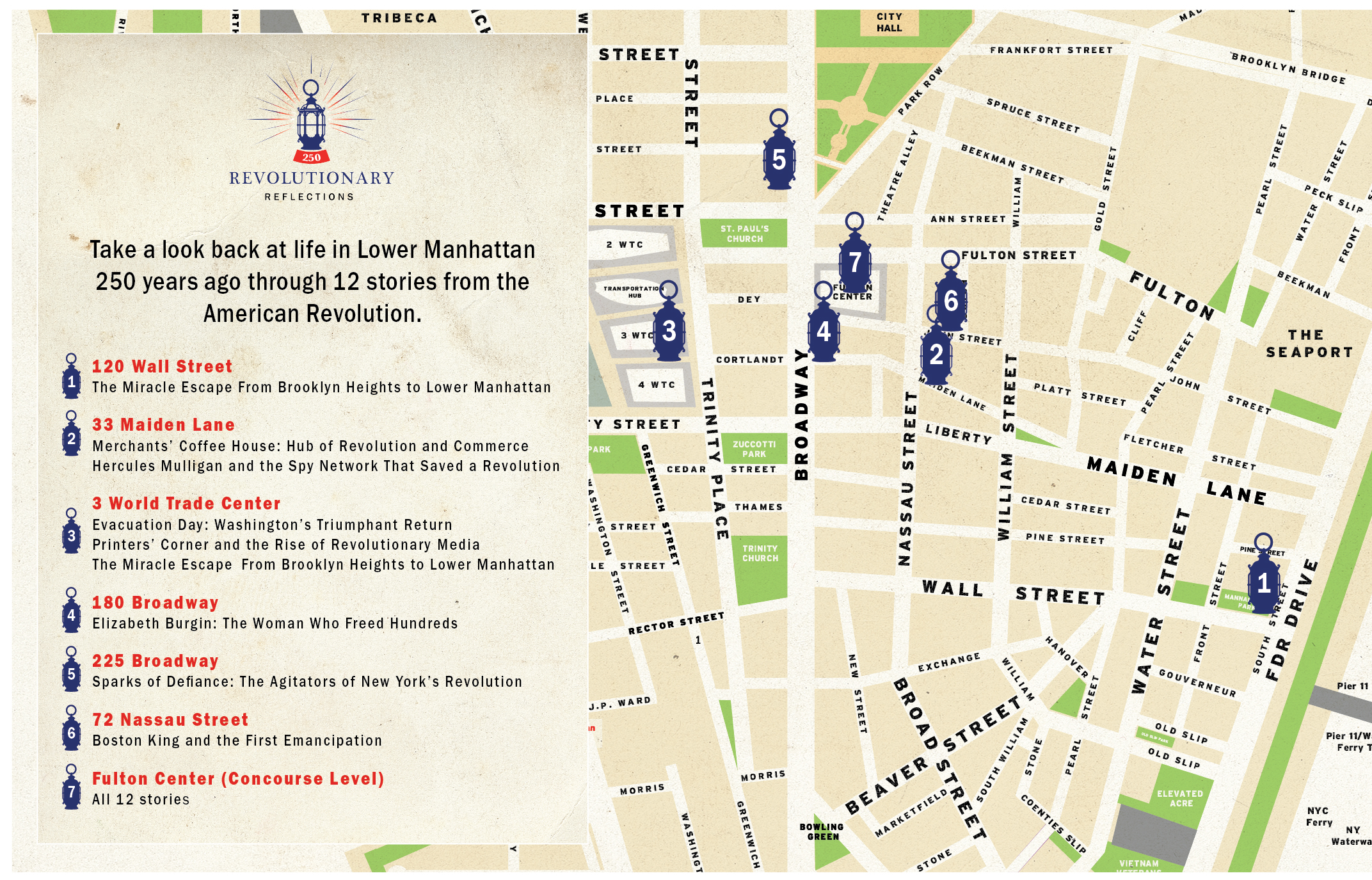
From Memorial Day to Labor Day 2026, you can find these artworks at seven locations across the neighborhood. Find them all on the map below, and read their stories here to learn more about Lower Manhattan’s Revolutionary history.
Stories
New York in Flames: The Great Fire of 1776
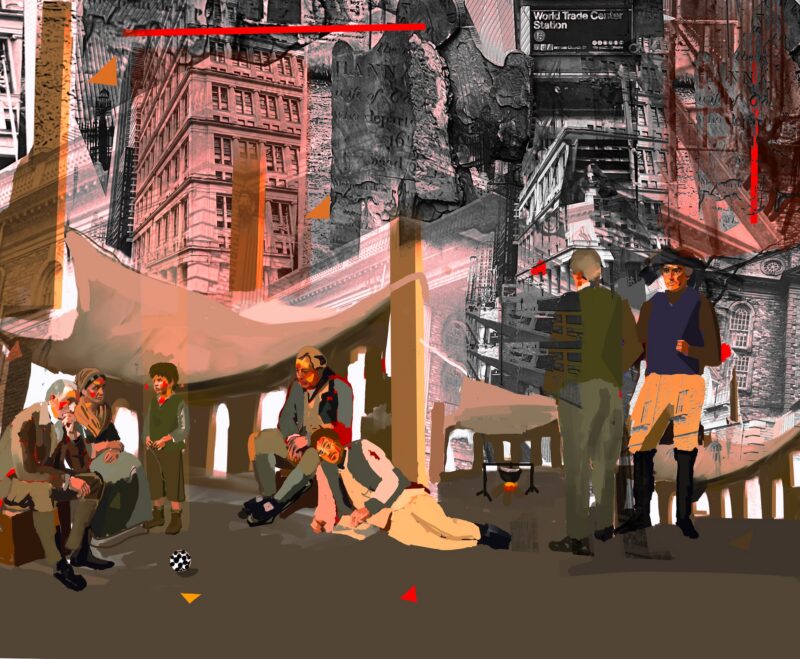
Days after the Battle of New York, which left Manhattan in British hands, a midnight blaze on September 20, 1776 tore through Lower Manhattan, destroying nearly a quarter of the city and threatening total ruin before shifting winds halted its spread. Long preceded by fears that either Patriots or the British might burn New York — as had happened in other contested cities — the fire consumed landmarks like Trinity Church while sparing St. Paul’s Chapel, and left some 900 buildings in ashes. Suspicion of arson ran high, especially after “combustibles” were discovered in untouched areas.
Lacking proof, British authorities executed several suspects. In the devastation that followed, thousands of displaced residents and incoming refugees erected makeshift shelters among the ruins, forming a sprawling encampment known as Canvas Town. Over the next decades, as New York’s population surged and wartime hardship deepened, the area became synonymous with overcrowding, disease, poverty and vice, persisting as a rough, makeshift community until redevelopment finally began in the late 1790s.
The Birch Trials and the Fight for Freedom

At the start of the American Revolution, the British promised freedom to enslaved people who fled rebel owners, leading around 20,000 to escape — many to New York, which became a fragile “island of liberty.” As the war drew to a close, however, the threat of re-enslavement surged, with former owners capturing Black men, women and children in the streets. In response, British officials held the Birch Trials in 1783 at Fraunces Tavern, granting freedom papers to those who could prove loyal service. Among them was Dinah Archey, a formerly enslaved woman who had endured brutal treatment before joining the British in 1777. Living in Lower Manhattan’s refugee camps, she ultimately defended her liberty by successfully appealing to British authorities, securing freedom for herself and her children in a powerful act of resistance.
Toppling the King: The Fall of George III’s Statue

Originally erected in Bowling Green in 1766 to celebrate the repeal of the Stamp Act, the statue of King George III became a symbol of British authority. On July 7, 1776, after hearing the Declaration of Independence read aloud, a group of soldiers and sailors marched down Broadway to tear it down. The statue was dismantled, its head displayed as a trophy, and its body sent to Connecticut, where it was melted into tens of thousands of musket balls — transforming a symbol of monarchy into ammunition for the fight for independence.
Evacuation Day: Washington’s Triumphant Return
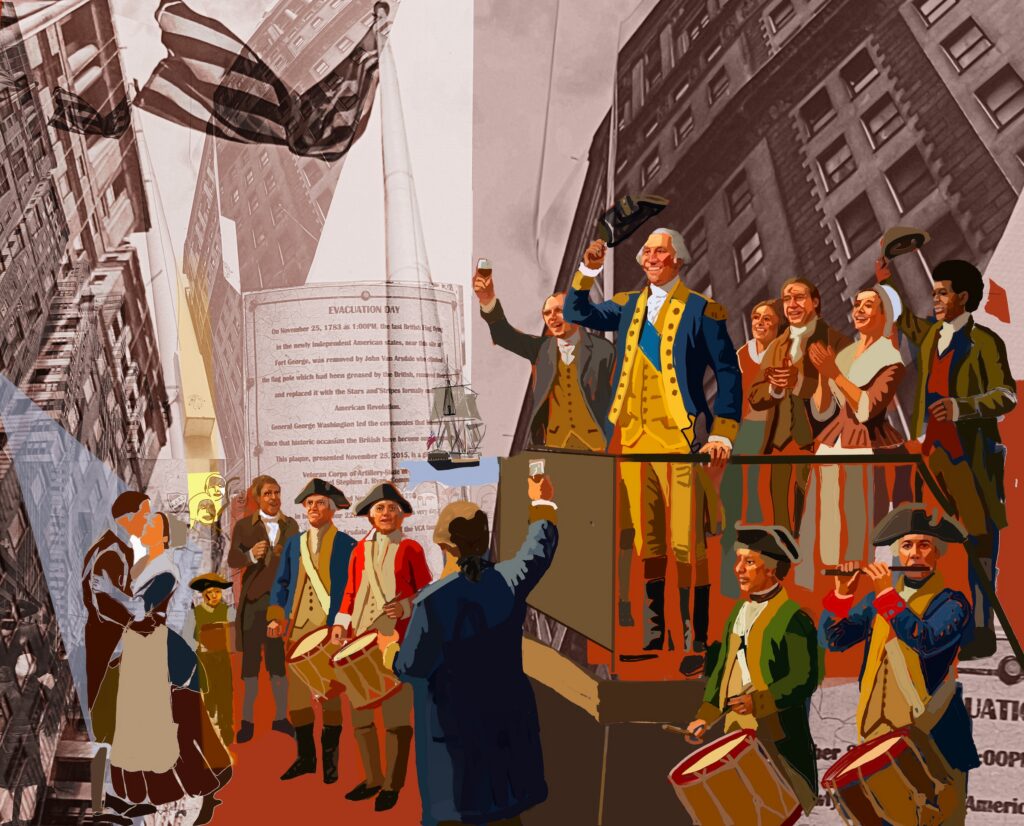
The American Revolution both began and ended in New York, with its final chapter marked by Evacuation Day on November 25, 1783. As the last British troops and Loyalists departed the city, George Washington led 800 Continental soldiers through the streets of Manhattan, greeted by thousands of cheering citizens. Homes, taverns and boardinghouses proudly removed British insignia, while the parade passed by sites of earlier rebellion, including Bowling Green, where the statue of King George III had been toppled seven years prior. When a sailor replaced the greased Union Jack at Fort George with the “Stars and Stripes,” the crowd erupted in celebration. Evacuation Day became a cherished local holiday, commemorating New York’s liberation and Washington’s triumphant return.
Boston King and the First Emancipation

Boston King was among the estimated 20,000 enslaved people who seized their freedom during the American Revolution, many of whom found refuge in British-held New York. Escaping a brutal master in North Carolina, King embraced what he called “the happiness of liberty” and went on to serve the British as a skilled carpenter and Loyalist soldier, even rescuing hundreds of men in battle. In Lower Manhattan, he built a new life — working, marrying and integrating into a growing community of formerly enslaved people. Yet as the war ended, the threat of recapture loomed, forcing King and thousands of others to evacuate to Canada under British protection. His story reflects a broader “first Emancipation,” as New York became a center of opportunity and uncertainty for Black Loyalists seeking freedom.
The Miracle Escape from Brooklyn Heights to Lower Manhattan
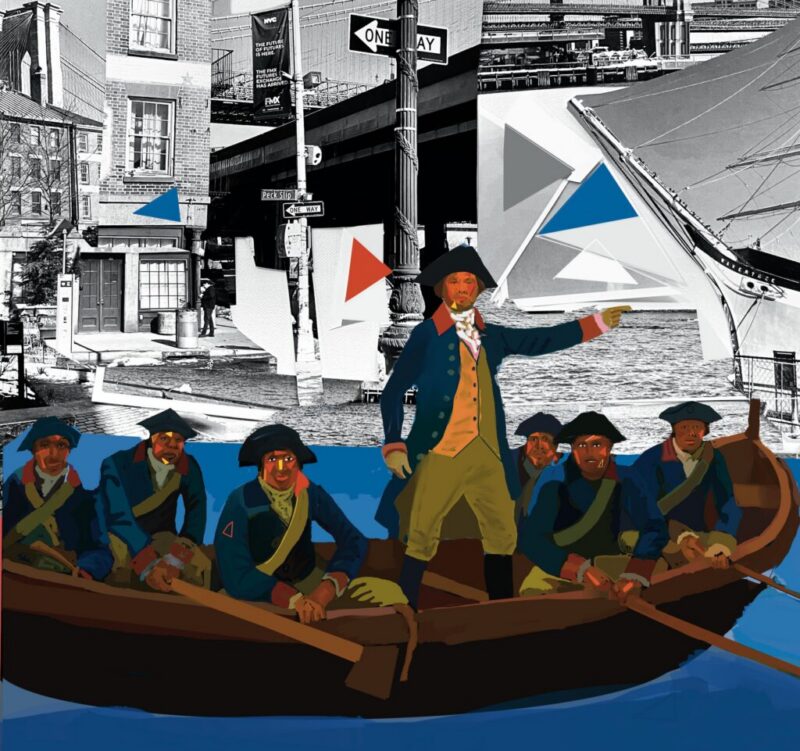
In the early days of the American Revolution, the patriot cause nearly collapsed during the Battle of Brooklyn, when George Washington’s army was trapped against the East River after a crushing defeat on Long Island. With British warships poised to strike, escape seemed impossible. Under the cover of a dense fog, however, the skilled mariners of the Marblehead Regiment — composed of white, Black and Native sailors from Massachusetts — quietly ferried the battered army across the river to safety in Manhattan. Their daring nighttime evacuation, often described by historians as a “Dunkirk-like miracle,” preserved the Continental Army at a critical moment and provided a vital boost to the revolutionary cause.
George Washington and the Birth of the Presidency

The balcony of Federal Hall marks the historic spot where George Washington was inaugurated as the first president of the United States in April 1789, establishing traditions still observed today, like placing a hand on the Bible. Washington’s election was remarkable not just for his leadership, but for his repeated rejection of absolute power, earning praise even from King George III. After the Revolution, he declined to seize authority, retiring instead to Mount Vernon, only to be persuaded to serve as president to legitimize the new Constitution. His unanimous election reflected public trust in his integrity, making Federal Hall both a monument to Washington and a symbol of the birth of American democracy.
Sparks of Defiance: The Agitators of New York’s Revolution

Amid rising tensions in colonial New York, Isaac Sears and Alexander McDougall emerged as powerful agitators who transformed protest into open resistance, helping spark some of the earliest violence of the American Revolution. Known as “the king of the mob,” Sears — a sea captain, orator and co-founder of the Sons of Liberty — rallied maritime workers and led dramatic acts of defiance, including raising liberty poles, helping provoke the Battle of Golden Hill, raiding British supplies and toppling the statue of King George III at Bowling Green. He also targeted Loyalists like James Rivington, endured repeated imprisonment, fled during the British invasion of 1776 and later returned from privateering to serve in public office.
Alongside him, McDougall, a Scottish-born merchant enriched through trade and privateering, channeled his influence into revolutionary politics. Through fiery writings, he denounced the Quartering Act as tyranny and accused British authorities of corruption, helping incite the clashes at Golden Hill, seen as the first bloodshed of the conflict. His defiance brought both widespread recognition and 162 days in prison, cementing his role as a key figure in the movement toward independence.
Elizabeth Burgin: The Woman Who Freed Hundreds

Elizabeth Burgin, a little-known but remarkable figure of the American Revolution, is believed to have played a vital role in aiding imprisoned patriots in British-occupied New York. Likely a soldier’s widow, she volunteered to deliver food and supplies to prisoners of war, using her access to secretly coordinate the escape of more than 200 rebels from makeshift prisons across Lower Manhattan. Praised by George Washington for her tireless efforts, Burgin likely evaded suspicion by leveraging her position as a charitable woman during wartime. However, her activities eventually drew attention, and in 1779 the British placed a bounty on her capture. Betrayed and forced to flee to Connecticut, she lost everything, but her bravery was later recognized with a pension from Congress.
Hercules Mulligan and the Spy Network That Saved a Revolution
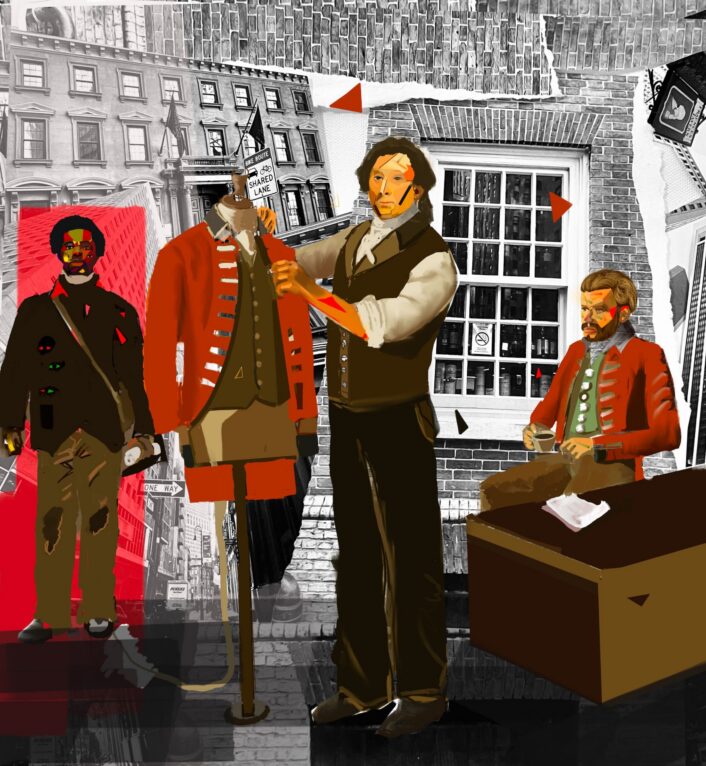
Hercules Mulligan, a key figure of the American Revolution with deep ties to Lower Manhattan, played a pivotal role both in open and covert intelligence. A member of the Sons of Liberty, he influenced Alexander Hamilton’s turn toward rebellion and took part in major prewar clashes against British authority. After the British occupied New York, Mulligan remained in the city, running a tailor shop in Hanover Square that doubled as a front for espionage within George Washington’s spy network. Gathering crucial intelligence from British and Hessian officers, he relied on his associate Cato — an enslaved man who became one of the most effective Black operatives of the war for the patriots — to deliver information. Together, they helped thwart multiple plots against Washington, contributing significantly to the survival of the revolutionary cause. After the war, Mulligan became an early advocate for abolition and freed Cato, marking a complex legacy of resistance and reform.
Printers’ Corner and the Rise of Revolutionary Media

In the late colonial era, Hanover Square — known as “Printers’ Corner” — stood at the heart of British North America’s information network, where news from London first arrived before spreading across the colonies, and as the Imperial Crisis deepened economic hardship, printers became powerful agents of influence on both sides of the growing divide. Patriot printer John Holt used his New-York Journal to unite resistance, famously adopting Benjamin Franklin’s “Join, or Die” image and earning the nickname “the liberty printer” before being forced to flee when the British retook New York in 1776, losing everything but leaving a lasting legacy in the cause of independence.
In sharp contrast, Loyalist printer James Rivington built his own media stronghold at Pearl and Wall streets with Rivington’s New-York Gazetteer, defending British authority and denouncing rebels so fiercely that his paper was derided as “Rivington’s Lying Gazette,” and his career was marked by upheaval — from the destruction of his shop by a rebel mob to his return as the “King’s Printer” under British occupation, and later suspicions of spying for George Washington — before continued hostility after the war left him destitute, a controversial figure whose life reflected the perilous balance between loyalty and survival in a revolutionary age.
Merchants’ Coffee House: Hub of Revolution and Commerce

The Merchants’ Coffee House, at Wall and Water streets, was the premier gathering spot for New York’s colonial elite, serving as a center for business, politics and revolutionary plotting. It hosted the Sons of Liberty as they planned to dump British tea, early discussions for a Continental Congress, and even served briefly as the seat of New York’s revolutionary government. In 1783, it welcomed George Washington for his triumphant return, cementing its place in revolutionary history. Beyond the war, the coffee house remained a hub of commerce and civic life, where Alexander Hamilton helped establish the Bank of New York, the Stock Exchange and the Chamber of Commerce, and where early benevolent and fraternal societies — including the nation’s first antislavery group — gathered.
Artists

Kate Fauvell, a New York artist, is inspired by people and systems. She photographs these as a way to document the world around her. Kate uses these images to create photo-based collage paintings that explore memory, impermanence, and the inner and visceral experiences that connect people. The fragmentation of torn photos depict how Kate sees our world systems — messy and broken. She uses these images to “rebuild” her city, neighborhood by neighborhood, into a place that seeks systemic justice and redefines beauty.

Naderson Saint Pierre is a self-taught artist whose vibrant, resonant works capture the essence of his subjects, particularly within the Black diaspora. Initially a hobbyist, Saint Pierre’s passion transformed into a full-time pursuit in 2016. His meticulous technique and keen eye for detail, honed through tireless dedication, have propelled him from painting in New York City’s subway stations and parks to a thriving international career. His impulsive move to NYC, fueled by talent and tenacity, overcame homelessness and led to numerous exhibitions and residencies.