
For many people, the World Cup is like the Olympics: a reason to watch a sport that’s otherwise not at the top of their priority list. And like the Olympics, it’s always more fun if you have at least some idea of what’s actually going on. If it’s been four years since you last watched a soccer match, never fear — we’ve got you covered with the basics, and also with some of the nuances you might miss on face value. Bone up on your soccer vocab, then check out our list of bars showing the games downtown, as well as special World Cup-related events in the neighborhood so you can fully get into the World Cup spirit.
The Basics
Two teams, 11 players each. Two halves, 45 minutes each. One ball. No hands, except for each team’s goalkeeper.
The pitch (or field)
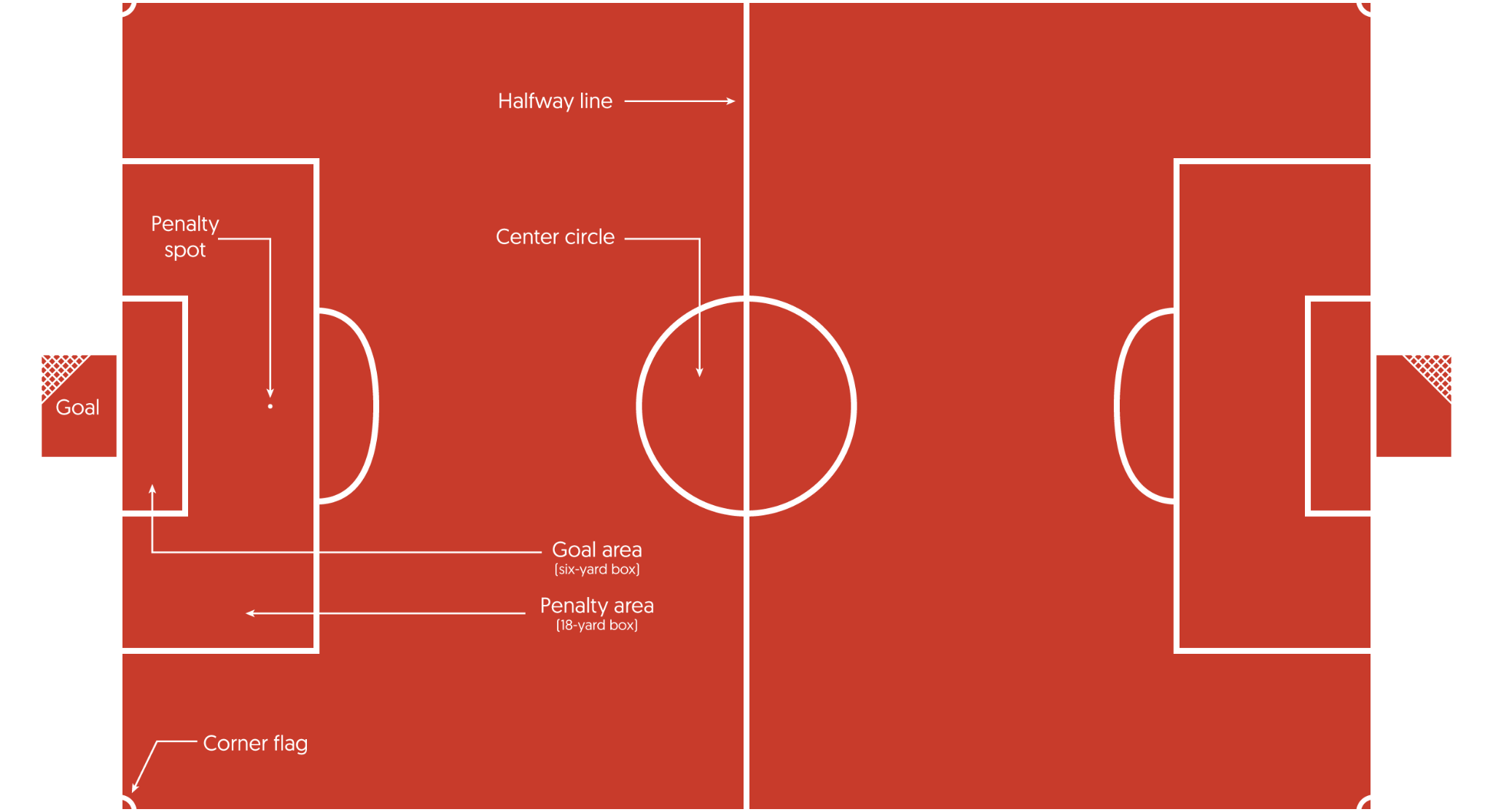
Curiously, there’s no set size for a soccer pitch — or soccer field, if you prefer — although there is a FIFA standard size, to which the pitches in the World Cup conform. The key parts are labeled on the diagram below.
Positions
For the sake of working out who plays where, teams are usually broken up into three basic roles: forwards, midfielders and defenders. Depending on their tactics, teams will put different numbers of players into each area: An attacking team might field four defenders, three midfielders and three forwards, while a more defensive team might opt for five defenders, four midfielders and a lone forward. Some of the position names you might hear, along with where you might expect to find that player spending most of his time, are set out below (assuming the team in question is attacking the goal to the left of screen):
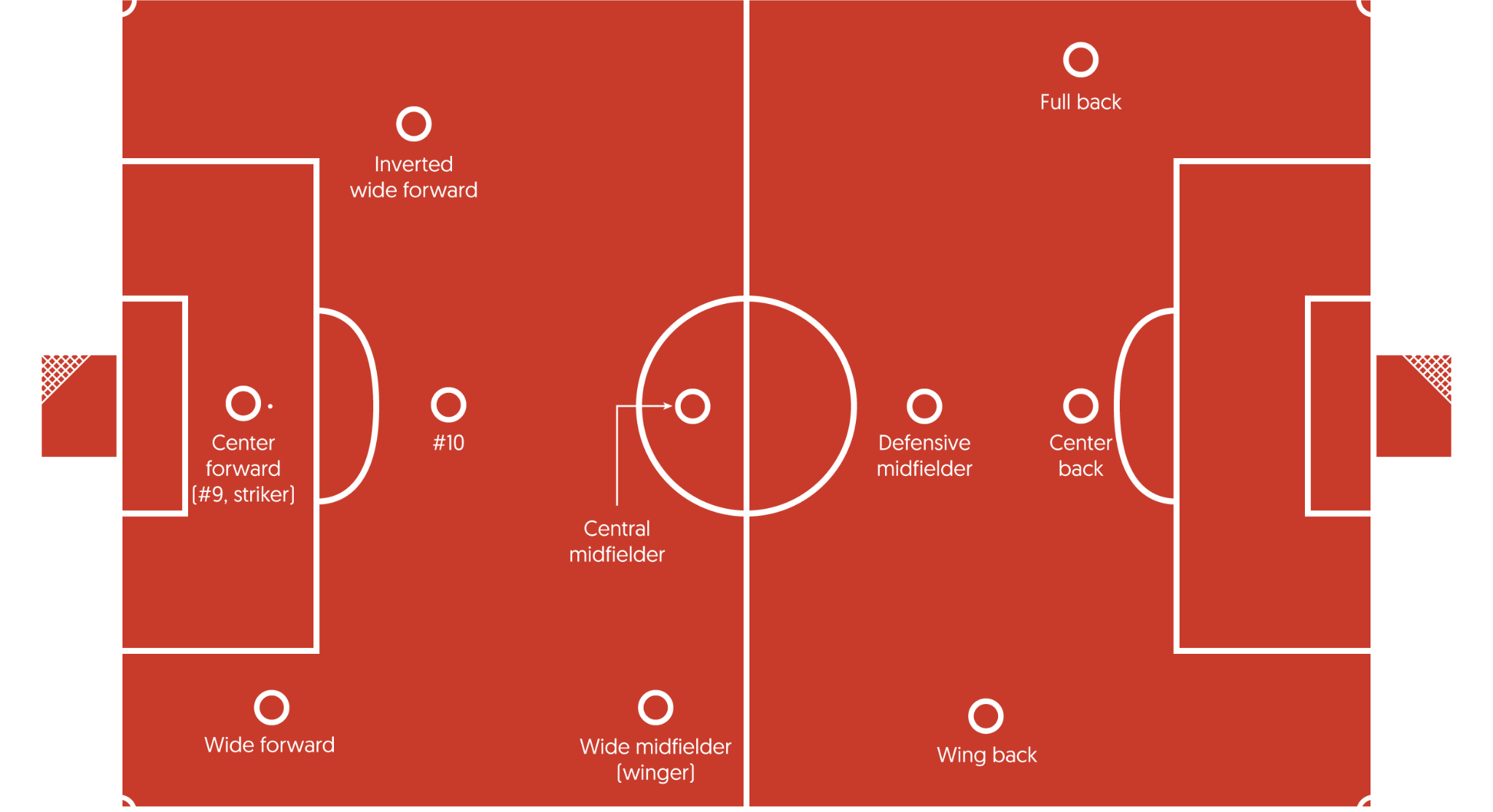
Positions are ultimately notional, though. There’s nothing to say a striker can’t drop back toward his own goal to reinforce his team’s midfield, or a defender can’t charge up the pitch, Leeroy Johnson-style, to join in the attacking. Even the goalkeeper can get involved if he wants, although the fact that this means leaving his goal undefended means it’s usually an act of last-minute desperation.
And speaking of the goalkeeper…
Goalkeepers
Goalkeepers are the only players allowed to use their hands, but there are limits to this. They can only handle the ball within their own penalty box. If they do so outside this area, it’s considered a foul, which we’ll get into in a minute.
If a team passes the ball back to their goalkeeper, he’s not allowed to handle the ball and must kick it like a “normal” player. If he does handle it, the other team is awarded an indirect free kick at the point where he did so.
The Slightly-Less Basic Basics
Wait, what’s an indirect free kick? Read on, friends.
Fouls and penalties
Generally, if a player fouls the member of the opposing team, the other team is given a free kick: they place the ball at the point where the foul was committed, and play stops until the free kick is taken. Free kicks are usually direct, which means that the kick can be a shot directly at goal if that’s what the team taking the free kick wants. If a free kick is close to goal, you’ll often see the defending team forming a wall of players to discourage this.
However, if the foul is committed by a team in their own 18-yard box — also called the “penalty box” — the attacking team is awarded a penalty. This is basically a free shot on goal: it’s a free kick taken from the penalty spot, which only the opposing goalkeeper is allowed to contest; all other members of both teams must remain outside and at least 10 yards from the ball the penalty box until the kick is taken. (This is also what the D-shaped marking at the edge of the 18-yard box is for, if you’ve ever wondered. It traces an arc 10 yards from the penalty spot.)
Red and yellow cards
As well as a free kick, particularly egregious fouls or other dastardly acts can be punished with either a yellow card or a red card.
A yellow card represents a caution; it’s basically the referee saying, “Don’t do that again.” It has no further consequences on its own, but if a player who has already received a yellow card receives a second one, then he immediately receives a red card.
A red card is a far more serious sanction. It means that the player is sent from the field of play. He can take no further part in the game, and he can’t be replaced by a substitute, meaning his team is left with one fewer player than their opponents. They’re not only issued as a result of two yellow cards. The referee can give a player an immediate red card (often called a “straight red”) for especially dangerous or aggressive acts.
There are also certain scenarios in which a red card is compulsory; these include a goalkeeper handling the ball outside his penalty area, a player fouling an opponent deliberately when that opponent is “through on goal” (i.e. there’s no defender between him and the goalkeeper), and various others.
Offside
The bane of casual viewers, the offside rule is traditionally explained with salt and pepper shakers, but we’ll make do.
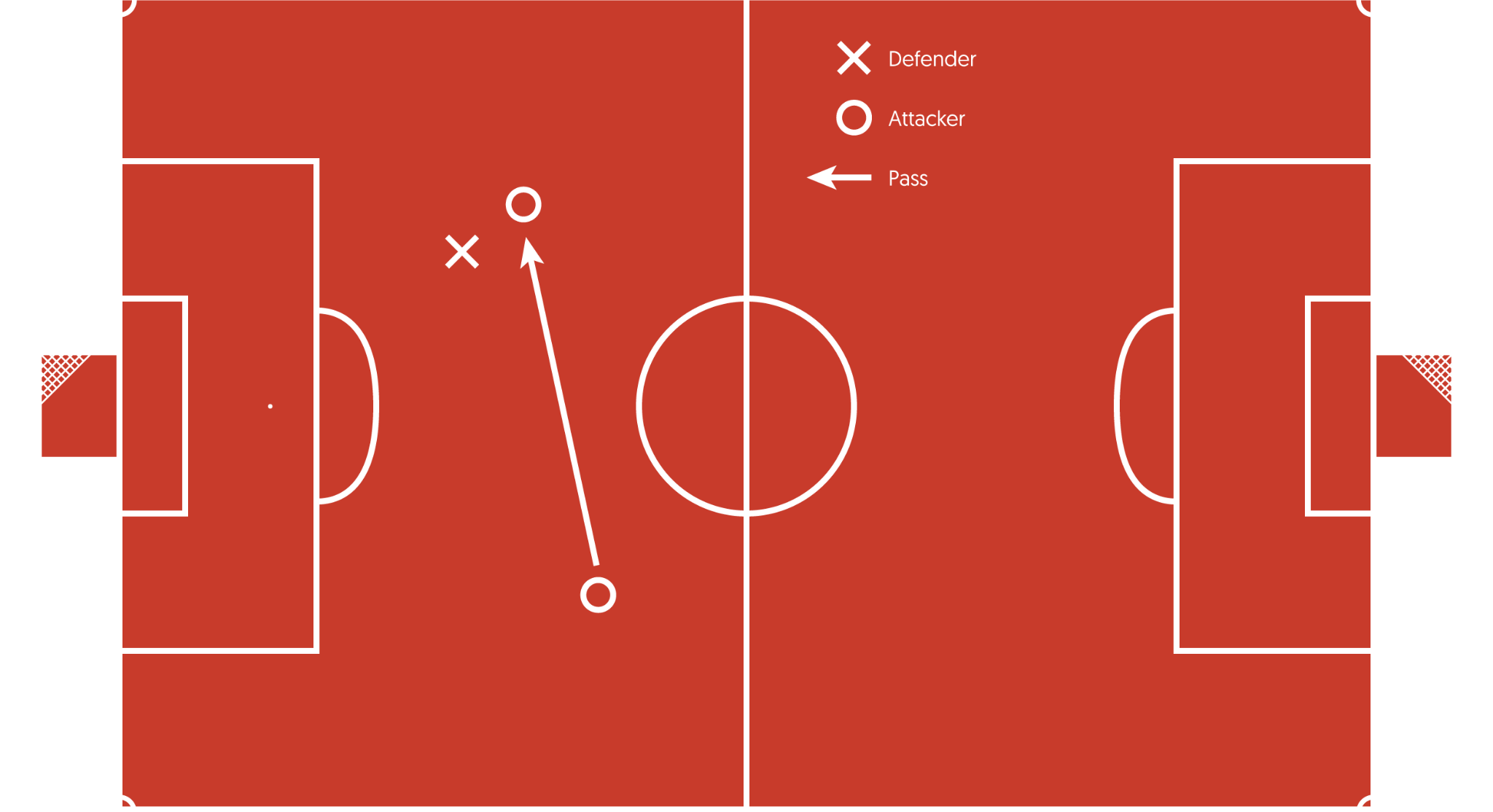
The basic idea with offside is that whenever a player passes the ball, there must be at least one defender between the recipient and the opposition goal. The effect of this rule is that a team can’t just leave players close to the opposition’s goal in anticipation of a turnover. Does that make sense?
Sort of?
OK, let’s use diagrams! In the following example, the attacking player is onside, because there’s a defender between him and the goal.
In this diagram, however, he’s offside:
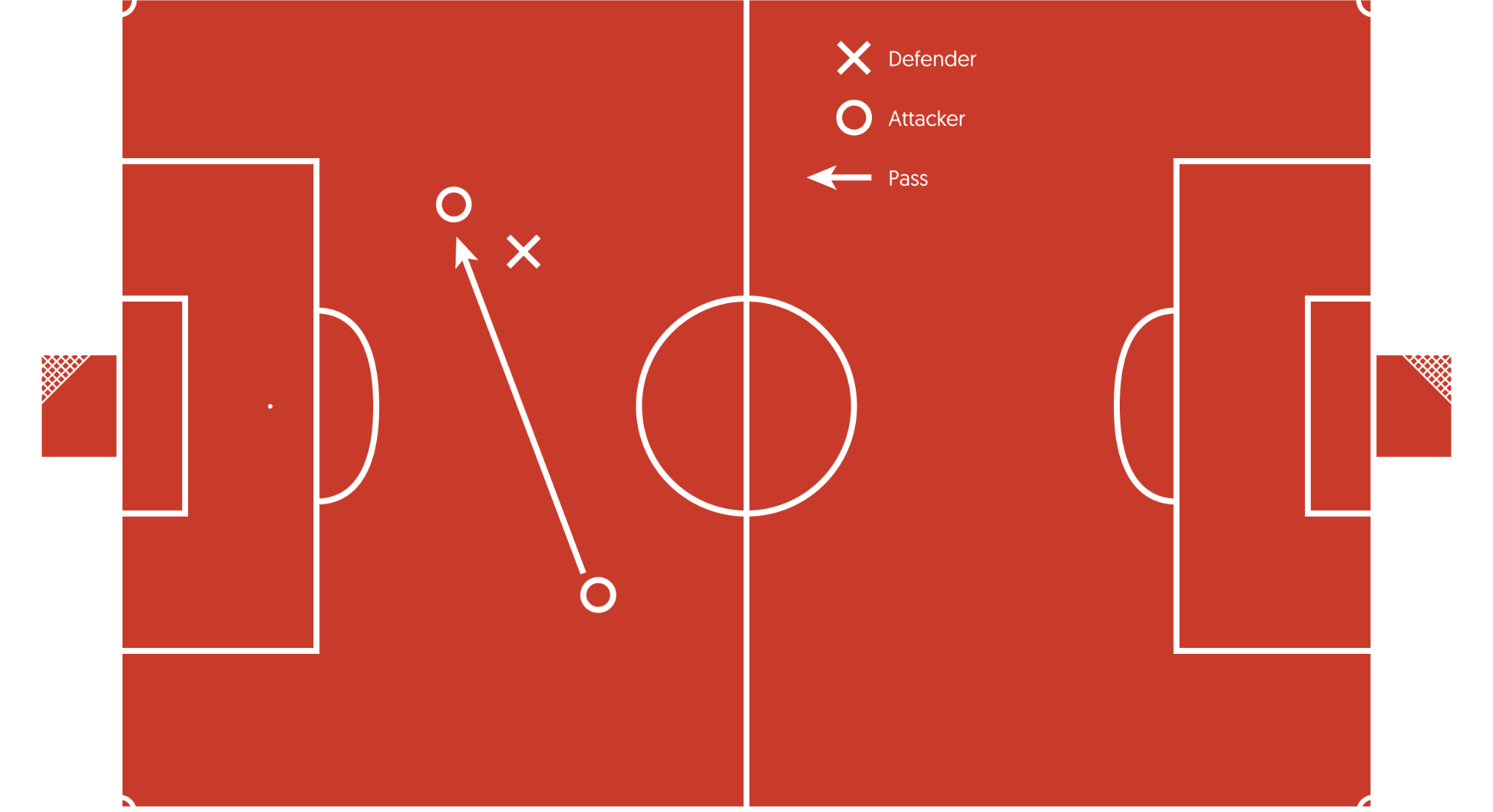
There are nuances here, the most important of which is that the key moment in determining whether a player is offside is the moment when the pass is made, not when it’s received. This means a player can start a run toward the opposition goal, and so long as they’re behind the last defender at the instant their teammate kicks the ball, they can be as far ahead as they want when they receive it. Note the diagram below:
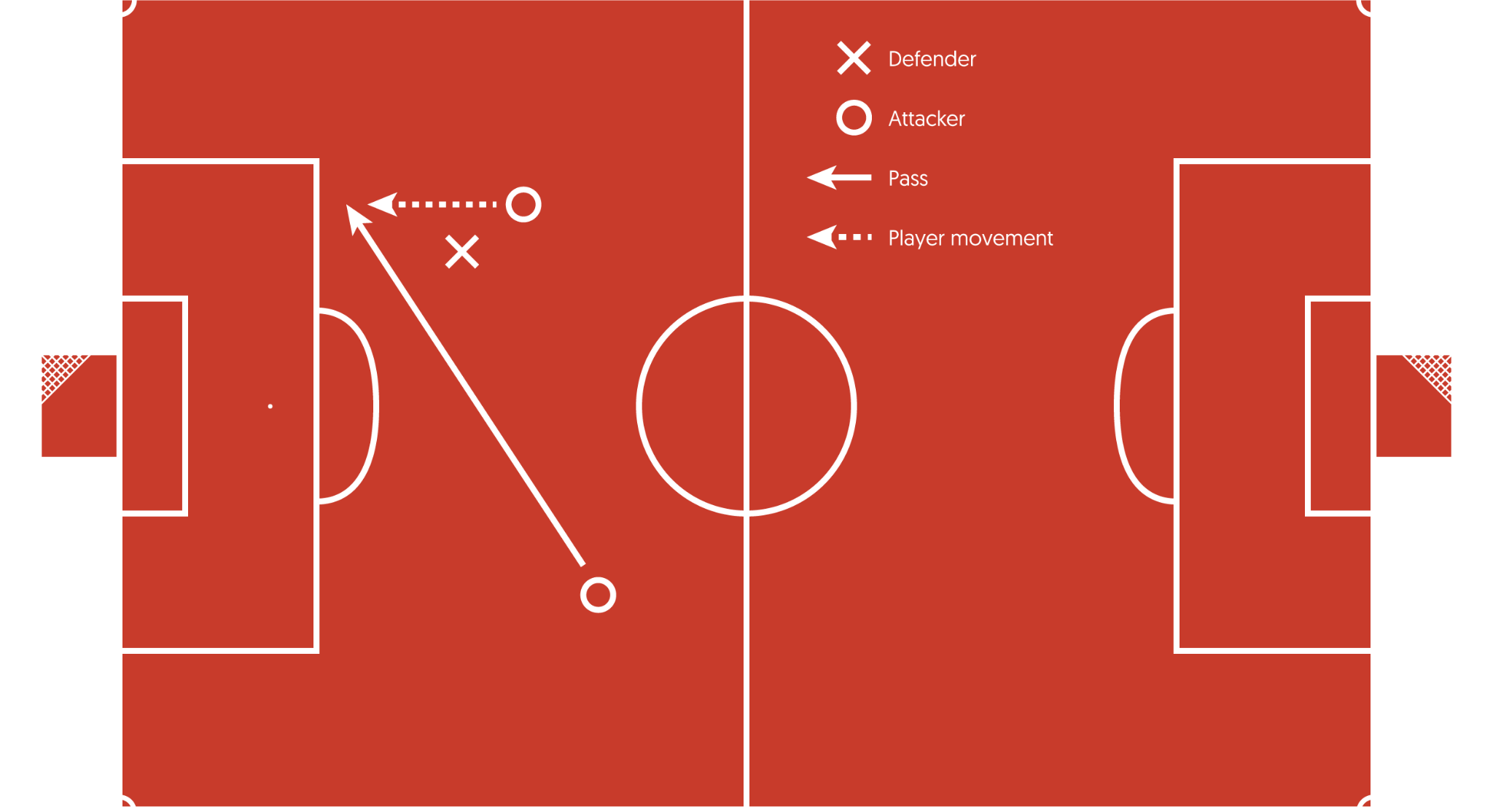
There are a couple of exceptions. You can’t be offside from a throw-in. And you can’t be offside if you were within your own half (i.e. closer to the goal your team is defending than the one it’s attacking) when the ball was played.
Extra time and penalty shootouts
The World Cup is divided into two stages: the group stage and the knockout stage. The former divides the teams into groups of four, where they contest a kind of mini-league, with three points awarded for a win, one for a draw, and none for a loss. The top two teams progress, and the third might progress due to rules that are a little too esoteric to explain here (though we did it in depth in our World Cup preview if you’re curious). Anyway, if a game during the group stage ends with scores level, it’s declared a draw, and that’s that.
However, during the knockout stage, there has to be a winner, so if scores are level at the end of the initial 90 minutes, the teams play an extra 30 minutes of added time. This is divided into two 15 minute halves. You may remember “golden goals” from previous tournaments, where the game would end as soon as one team scored — these are a thing of the past now, and the teams always play the 30 minutes of extra time in full.
If the scores are still level after extra time, then the game is resolved with the dreaded penalty shootout. This involves each team taking alternating penalty kicks. The teams toss a coin to see who goes first, and then they take an initial five penalties each. If one team scores more than the other, they’re the winners. And if the initial five penalties fail to separate the teams, then the shootout goes to sudden death; if one team misses, if the other scores, it’s all over, with the team who scored declared victorious.
VAR
This is short for “video assistant referee,” and it refers to the use of technology to assist the on-field referee and team in their decision making. There are a couple of reasonably straightforward ways in which it’s used, along with some more controversial ones.
Goals
The ball is equipped with a position sensor, and the referee’s watch will buzz if the ball crosses the goalline. Easy.
Offside
Offside decisions are checked with cameras; the VAR can freeze the moment a ball was played to see if the player receiving the pass was offside or not. Easy. In theory. Unfortunately in practice these decisions can be extremely tight, and sometimes, regardless of how fast your camera is, it can be difficult to isolate exactly when the pass was made. And it can be galling to see your team have a goal disallowed because a player’s nose was offside, or something.
Fouls and cards
The VAR monitors the game and can recommend that the referee halt the game to review footage on a pitchside monitor if they feel a serious foul was committed that the referee didn’t see. The VAR can recommend that a referee reconsider the issue of a card, either upgrading from yellow to red or vice versa. And they can recommend that a referee reconsider his decision if they feel a “clear and obvious error” occurred. This last point is clearly subjective, and its subjectivity has led to all manner of, um, spirited discussion in online forums.
Now you’re a soccer expert! And if you want to really impress your soccer enthusiast friends with your knowledge, check out our incredibly detailed power rankings of all 48 teams in the tournament and start picking your favorites.
Tom Hawking is a Brooklyn-based writer, editor and football fanatic. Find him at his website.
main photo: iStock


